
Tea Time: Dragonwell – Part II
Another take on this classic Chinese tea from Cup and Kettle

One of the things I enjoy about classic teas is how widely available they are. Sure, some shops specialize in blends and/or herbal teas; however, for the most part, the classics are available in most shops. The quality can vary, but they are still there. Another characteristic of classic teas that I enjoy is their simplicity. There is no need to add anything extra to make the tea “pop,” so to speak. They stand on their own. As such, they can also be compared. How does the quality of a tea compare between companies? What about this year’s harvest versus last year’s? By comparing tea, you can note differences that may arise from different growing conditions, whether from annual or spatial differences. What’s more, you may find that you prefer one vendor’s (or source’s) tea over another, potentially making it a staple in your home.
Given my tea preferences, I frequently order the same types of tea (as a constant), even if the vendor changes. As such, I will cover some teas that I have already written about. And rather than reinventing the wheel, I can jump right into discussing the specific tea (and its vendor, if new).
One thing to note before we begin: tea is, in certain respects, similar to sake: the best cup is the one you are enjoying (at the moment). Regardless of your tea’s grade, if you like it, then that is all that matters. My pretentiousness aside, I like to live by that. So drink what you enjoy.

Dragonwell
The tea that I am covering today is the Dragonwell (Longjing) from Cup and Kettle in Bloomington, IN. Since I have already talked about the store (see the very first Tea Time), I will just cover some recent changes. In a few of my posts, I may have mentioned that the store experienced extensive water damage in December 2025. Consequently, the shop had to close for repairs. This was less than ideal because business had declined due to ongoing repairs to the building’s exterior (it is an old, stone/brick-and-mortar, multi-use building) over the last year or so. Anyway, I purchased this not long after the shop had been damaged by water. Although the road to repair is long, and the shop’s future remains uncertain, the owner is still fulfilling online orders. With all that was going on, it took a little while for the order to arrive. (Honestly, if it had never shown up, I would have been fine.) But I was delighted when a little package full of tea arrived at my door. So, if you feel inclined, I encourage you to buy some tea from Cup and Kettle to help out a small business (and have a nice, thoughtful cup of tea).
(Don’t) Spill the Tea
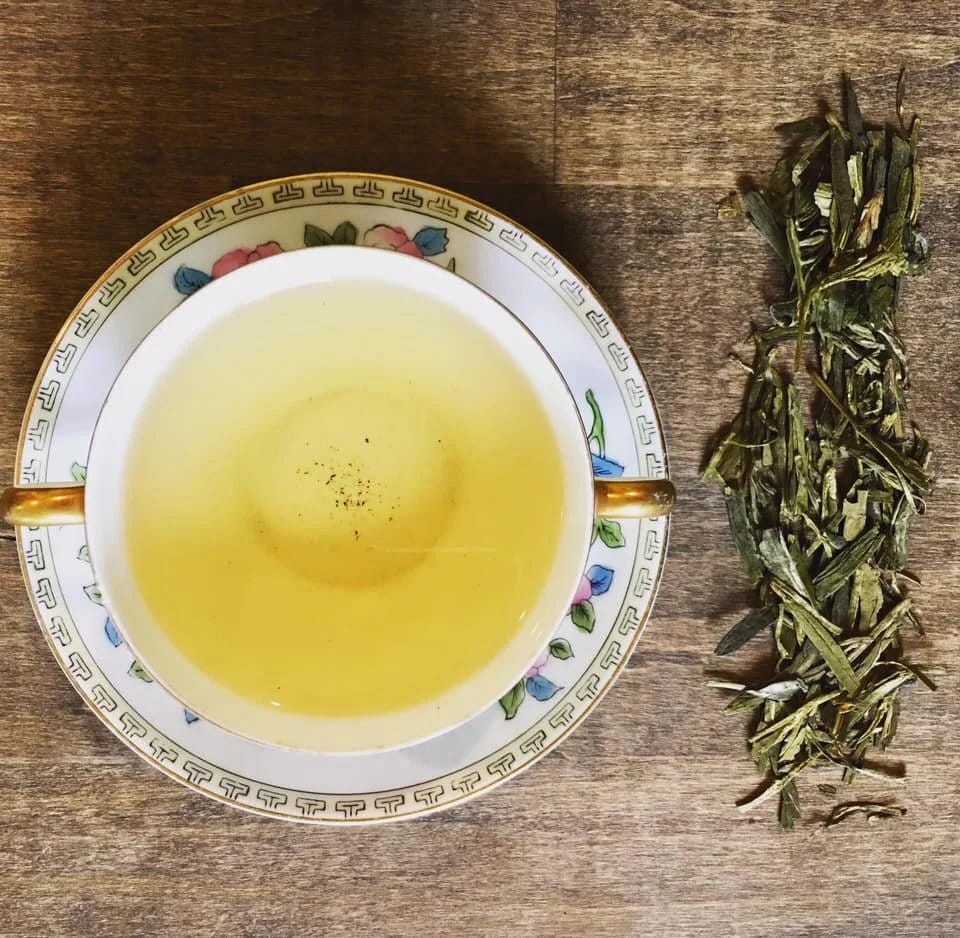
The first thing that I noticed about this tea was its scent. Overall, it smelled like dry grass or fresh straw. Even after finishing this tea a few days ago, I can still smell it in the now-empty canister in which it was stored. Aromatically, this was an absolute delight.
Visually, the leaves were a darker shade of green, with some variation in coloration and splotchiness. While this would be indicative of lower-quality tea, it was contrasted by the full, flat leaves that were common throughout this blend. Generally, everything was uniform, though a few broken leaves were present.
While this would not be considered a premium (or imperial) tea, the flavor was generally great. The straw aroma really comes out following an infusion, though the taste remains somewhat mild. It was still grassy, albeit somewhat muted. In general, I think that made for a light, somewhat refreshing drink. I will say this tea was not as forgiving with steep times. Oversteeping can easily result in an astringent drink that becomes overwhelming. In those cases, the bitterness seems to linger, whereas an appropriately brewed cup has front-end grassy flavors that subside rather quickly. This was especially true when brewed gongfu-style. Honestly, this tea was pretty good for that, though I would probably use substantially more tea if in subsequent gongfu sessions. Overall, I think this was a good Dragonwell, one that would be ideal for everyday purposes.
One last thing: I got a chance to try this grandpa style while I was doing fieldwork. Briefly, grandpa style is where you just put the leaves in your cup, pour in water, and drink from there. When the water drops to about 25 % of the starting volume, add more water. Given the size of the leaves, it was generally pretty easy to keep them out of my mouth and in my camp mug. (I cannot say the same for my pu’er or oolong.) It made some of the harder (and absolutely frigid) mornings a little more enjoyable.
Instructions
~2–2.5 g (2 tsp) per 237 mL (8 fl. oz.) of filtered water
For gongfu, I would probably use 4–5 g, depending on the size of your gaiwan. I was able to get by with 3–3.5 g, though generally, it is better to go with more tea rather than less.
Water temperature: 82.2 °C (180 °F)
Use filtered water.
I stuck with this temperature pretty regularly, though I did try out 79.4 °C (175 °F) and 85 °C (185 °F) and had great results.
Steep for 2 minutes
2.5–3 minutes is also fine. I would avoid 3.5+ minutes.
For gongfu, start with a steeping time of 20–30 seconds, and gradually increase the time by 5–10 seconds from there.
For gongfu, I would have an appropriate cup to pour into from your gaiwan. Whether that is a cup the same size as your gaiwan or several small cups will depend on your setup. Regardless, you do not want the tea to be left in the gaiwan only to become bitter (unless it is diluted in a subsequent steep). Generally, I could get 3 solid infusions out of this, with a possible fourth one if I added a few more leaves.
Conclusion
This tea was a standard Dragonwell. I think compared to the Dragonwell from Arbor Teas, it might have been a little less flavorful or distinct. While this tea might not stand out, I think it makes an excellent everyday tea. Honestly, aside from the occasional oversteeped cup thanks to my negligence, I don’t think I had a bad time with this tea. If you have a chance to get it, I think it would be worth trying, especially if you have never had Dragonwell before. This was my introduction to the tea (years ago), and I have been enjoying it ever since.
Until next time.